
Casinos That Accept POLi in the UK: Payment Guide
 Available in GB
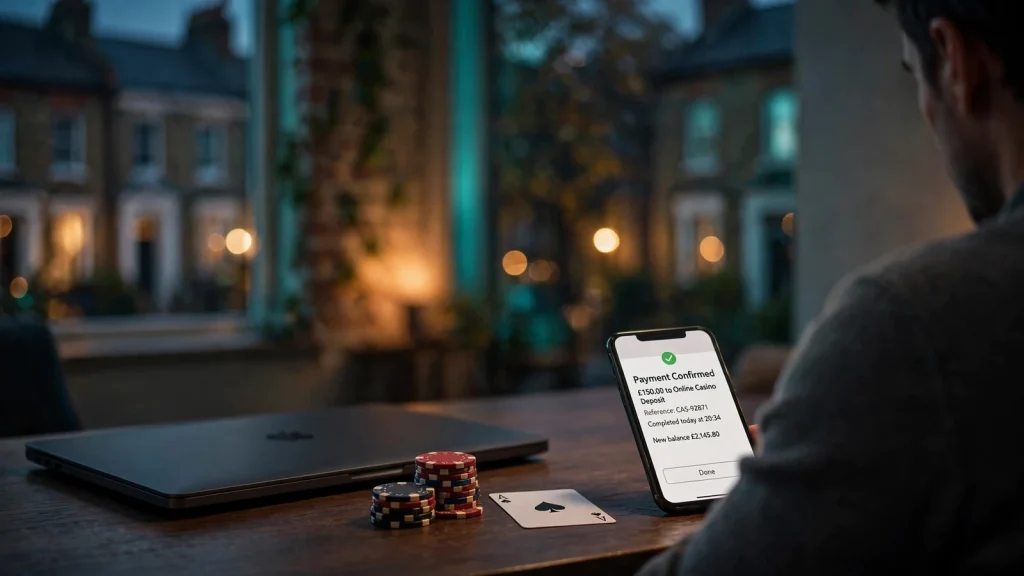
POLi is a way to fund an account, not a slot category, and its availability for deposits does not establish the withdrawal route.
Table of Contents
- POLi, Slots and the Limits of the Connection
- Deposits, Minimums and the Cashier’s Small Print
- Checking Whether a Casino Actually Supports POLi
- Cards, Payment Routes and UK Compatibility
- Slot Play Is Not a Payment Feature
- Other Ways to Move Money into a Casino Account
- When POLi Is Missing from the Deposit Screen
- Why a POLi Deposit Does Not Promise a POLi Withdrawal
- A Deposit Is Only One Half of the Payment Route
- POLi and Claims About Casinos Outside GamStop
POLi, Slots and the Limits of the Connection
A casino’s cashier and its slots catalogue answer different questions. The cashier describes how money may enter an account; the catalogue describes the games the casino makes available. A POLi label, where a casino displays one, belongs to the first category. It does not identify a special class of slots, nor does it show that a particular game can be played only after a POLi deposit.
That distinction matters because payment language often travels further than the payment itself. A search for casinos with POLi and slots may seem to promise a joined-up feature: a way to deposit, followed by a particular set of games. In practice, those are separate parts of the service. A deposit method does not alter a game’s rules, make a title exclusive to that method, or establish what appears in an individual account’s catalogue.
The same applies to lists of “POLi slots”. Without a confirmed connection between a payment route and a named game, such a list would give the impression of a product category that the payment method does not create. The useful distinction is less glamorous: one choice concerns funding an account; another concerns what the casino offers for play. The two may sit on the same website, but proximity is not proof of a special relationship.
When looking for a casino that accepts POLi in the UK, check that the payment method is currently available before signing up. The details here provide a limited point of reference on payouts.
1. Jetsetspins
Payout speed: 1-3 business days Jetsetspins lists a payout speed of 1–3 business days.
2. NightWin
Payout speed: 1-3 business days NightWin lists a payout speed of 1–3 business days.
3. Amunbet
Payout speed: 1-3 business days Amunbet lists a payout speed of 1–3 business days.
4. NightLuck
Payout speed: 1-3 business days NightLuck lists a payout speed of 1–3 business days.
5. Chanze
Payout speed: 1-3 business days Chanze lists a payout speed of 1–3 business days.
6. Zombillion
Payout speed: 1-3 business days Zombillion lists a payout speed of 1–3 business days.
7. BeOnBet
Payout speed: 1-3 business days BeOnBet lists a payout speed of 1–3 business days.
8. SpinFormula
Payout speed: 1-3 business days SpinFormula lists a payout speed of 1–3 business days.
9. Dieselwin
Payout speed: 1-3 business days Dieselwin lists a payout speed of 1–3 business days.
10. x3bet
Payout speed: 1-3 business days x3bet lists a payout speed of 1–3 business days.
Casino accounts also gather several different decisions under one login. Payment options, games, account settings and promotional terms may be presented alongside one another, yet each has its own conditions. The presence of a slot in a catalogue does not tell a player which payment methods are available. Equally, seeing a payment brand mentioned in casino material does not establish that every game in the catalogue is linked to it. A label is not a bridge.
This is why claims about the “best slots with POLi” need careful handling. “Best” might refer to a player’s preferences, while “with POLi” might refer to a cashier option; neither phrase supplies evidence that the two are connected. The catalogue may contain many titles, but a payment method does not rank them or make one more suitable than another. A list that places game names beside a payment logo can therefore imply more than it explains.
Promotions add another layer. A bonus is governed by its own terms, and payment eligibility should not be inferred from the name of a deposit method alone. A specialist casino review describes PayPal as valued for speed and convenience, while noting that promotions may exclude it. That observation concerns PayPal; it does not establish a parallel rule for POLi. Nor does it mean every PayPal promotion is excluded. The terms attached to a particular offer are the relevant text, not an assumption carried over from another payment route.
Casinos That Accept Revolut in the UK: What to Check · Casinos That Accept Klarna in the UK: What to Check
This distinction can sound fussy until a bonus is involved. A promotional offer may depend on its stated conditions, and payment eligibility is one possible condition to read. But a general comment about one method cannot settle the status of another. The sensible description is not that POLi deposits qualify, or that they do not. It is that the method and the offer must be considered separately, with no automatic conclusion borrowed from PayPal.
The word “casino” can make these categories seem more unified than they are. A single brand presents a cashier, account tools and a selection of games as one service; the interface encourages the eye to treat them as one package. Behind that presentation are distinct functions. Money moves through a payment route. Games sit within a catalogue. Promotions have separate rules. A connection between any two requires something more than their appearance on the same page.
The UK setting adds an important boundary to any real-money play: remote gambling operators serving Great Britain must hold the relevant Gambling Commission licence, and legal online gambling is available through licensed and regulated sites to adults aged 18 and over. That regulatory status does not turn a payment option into a game feature. It governs the operator’s permission to provide the service, not a special relationship between POLi and particular slots.
UK Regulatory Requirement
Remote gambling operators serving Great Britain must hold a Gambling Commission licence, and legal online gambling is available to adults aged 18 and over.
So the phrase “casino slots with POLi” is best understood as shorthand for two interests that happen to meet at one casino account. It is not evidence of a dedicated POLi game library, a guaranteed bonus, or a ranking of titles. The payment route and the catalogue remain separate. Quite deliberately.
Deposits, Minimums and the Cashier’s Small Print
The advertised payment method is only part of a deposit decision. The amount accepted at the cashier can depend on which route is selected and on the status of the account, so a figure attached to one option should not be assumed to apply to another. This matters when comparing casinos that accept POLi deposits: the method’s presence, where offered, does not by itself tell a player what the minimum or maximum transaction will be.
A specialist casino review puts the starting minimum across the sites it examined in the £10–£20 range, with the selected payment method affecting the figure. That is a reported range, not a market-wide promise or a fixed POLi threshold. A cashier may display a different minimum for a different route, and the amount shown for an account can be more relevant than a general figure quoted elsewhere. The small print begins with the amount field.
Casinos That Accept Solana in the UK: What’s Verified · Casinos That Accept Apple Pay in the UK: The Evidence
The maximum is less readily reduced to a single headline number. A casino may set caps per transaction, per day or per month, and the applicable ceiling can vary with both the payment method and account status. A specialist casino review notes this variation; it does not establish one universal limit for every player or cashier. A maximum shown for a card, for instance, should not be treated as the maximum for a bank-based option or any other deposit route.
Those distinctions turn the cashier into more than a place to press a button. It is where the amount and method meet the conditions attached to the account. The interface may show a permitted range after a route is chosen, rather than presenting every condition on a general payments page. A listed minimum can therefore be a useful starting point, but not a substitute for the figure displayed during the transaction itself.
The word “minimum” also invites an unhelpful shortcut: the assumption that a small first deposit will be available on every listed method. It need not be. The cashier’s own amount controls define what can be entered for the selected route, while account-level conditions may affect the applicable maximum. A casino’s broad payment description cannot settle those details in advance.
For people comparing POLi casinos, this is a separate question from whether POLi appears as a deposit option at all. The amount limits should be read only in the context in which they are shown: the selected route, the account and the transaction. A figure attached to another payment option cannot be transferred by analogy. Nor does a broad minimum range demonstrate that a particular casino supports POLi.
Do
- Check the amount field in the cashier
- Verify the specific route selected
- Read the current account status
Don’t
- Rely on general market-wide promises
- Assume one route’s limit applies to all
- Use a general figure as a substitute
The difference between a per-transaction ceiling and a daily or monthly cap is practical. A transaction can fall within one threshold while the account’s wider allowance is governed by another. The limits are not interchangeable labels. When a cashier presents more than one condition, the relevant one depends on the amount being deposited and the period covered by the stated cap. The display, not a generic comparison, supplies that context.
Account status matters alongside method because the maximum deposit allowance can vary with it. That does not mean every casino uses the same status categories or makes its calculations visible in the same way. It means an old figure, or one reported for another account, should not be treated as a dependable personal allowance. Limits belong to the particular account and route, not to the payment method in the abstract.
There is a broader UK safeguard around the first deposit: remote gambling licensees must invite new customers to set a financial limit before money is deposited, and account-level controls must remain accessible. That is a protection for managing spending, not a statement of the casino’s minimum deposit or its payment-specific maximum. The two kinds of limit serve different purposes. One is a boundary chosen for account management; the other is a condition of the cashier.
This distinction is easy to lose when payment information is condensed into a comparison table. A minimum may be presented as though it belongs to the casino as a whole, while the cashier applies it to a particular method. Maximums may likewise be described without making clear whether they concern a single transaction or a wider period. A neat summary can conceal a messy interface.
Casinos That Accept Boku in the UK · Casinos That Accept Click2Pay in the UK: What to Check
For a meaningful comparison, the amount and its condition need to stay together: minimum for which route, maximum over which period, and whether it applies to the account in its current status. Without that context, the number is merely a fragment. Deposit limits are not decorative terms. They shape what the cashier will permit.
Checking Whether a Casino Actually Supports POLi
A casino’s payment options are not a permanent feature printed into its name. They are part of a working cashier, and the cashier is the place to establish whether POLi is available for a particular account at the time of use. A search result, comparison page or old review can describe an earlier version of the service; it cannot confirm what appears after sign-in.
The distinction matters because “accepts POLi” may sound like a simple property of a casino, when payment access can depend on the route currently offered to a customer. A site may display a payment logo on a general information page without showing that method in the deposit screen. Conversely, a list that omits POLi may simply be out of date. Neither is conclusive. The cashier is less glamorous than a badge, but rather more useful.
A careful check begins with the casino’s own payment area. Sign in, open the deposit screen and inspect the methods actually presented there. If POLi is named as a selectable option, that is stronger evidence of current availability than a third-party listing. If the cashier instead shows other methods, it does not establish POLi support merely because an old page or a search snippet says otherwise.
Checking POLi Availability
Sign in
Log into your casino account to access the personal cashier.
Open deposit screen
Navigate to the cashier and open the area where deposit methods are listed.
Inspect methods
Check if POLi is explicitly named as a selectable option for your account.
Contact support
If the method is not visible, ask customer support to clarify current support for your account.
There is a further distinction between seeing a payment brand mentioned and being able to use a particular product. A specialist review lists Visa and Mastercard among the payment methods, but that should not be read as a blanket confirmation for every UK customer, every card product or every account. Current availability and eligibility still need to be checked in the cashier. Payment names can travel farther online than the conditions attached to them.
The screen should be read as an account-specific statement, not as a broad promise. A method may be visible in general information yet absent from the signed-in cashier; a method may also appear only after the relevant account details are in place. Where the screen offers no clear indication, the operator’s customer support can clarify whether POLi is currently supported for that account. A confident answer about a different casino, or about a previous visit, does not settle the matter.
This is why lists titled “best POLi casinos” need a second look before they are treated as practical guidance. The useful detail is not a ranking or a logo but a current, usable option in the operator’s own deposit flow. Even then, availability should not be confused with a guarantee that every transaction will be accepted: a displayed method answers whether the route is offered, not every question about an individual payment.
The same habit applies when a page names familiar card brands. Visa and Mastercard are commonly accepted as debit cards at UK casinos, but a reference to either brand does not by itself confirm that a specific product will work in a particular cashier. That check belongs where the transaction begins. A logo is an invitation to verify, not proof of access.
Casinos That Accept Bitcoin in the UK: What’s Verified · Casinos That Accept USDC in the UK: What to Check
For the question of whether any casino currently accepts POLi, the responsible answer is therefore conditional: the cashier must show it. Old references can point towards something worth checking; they cannot do the checking.
Cards, Payment Routes and UK Compatibility
A debit card and a bank-payment route can meet at the same account without being the same thing. Visa and Mastercard are card networks; POLi is named as a payment route. A casino’s acceptance of one does not establish acceptance of the other, even if both ultimately draw on a customer’s bank balance. The distinction matters because “debit card accepted” is not a general promise that every payment product connected to a bank will work.
UK casinos commonly accept Visa and Mastercard debit cards. That describes a broad category, not every card bearing either logo or every way of presenting it. A particular card product may have its own eligibility conditions, and a payment route may be available in one setting but not another. For online casinos accepting POLi payments, the relevant question is therefore not simply whether the casino takes debit cards. The two labels answer different questions.
The same distinction applies to mobile play. A casino may offer a mobile site or app and accept debit-card deposits there, while a particular POLi route remains a separate matter. “Mobile-compatible” describes the place where the transaction is attempted; it does not identify the payment rail or confirm that a card product is eligible. A familiar interface can make several systems look like one service. They are not.
Credit Card Ban
Credit-card payments for gambling are prohibited at UK-licensed casinos; this rule applies regardless of whether a wallet or intermediary is used.
There is also a boundary that cannot be blurred by changing the route. Credit-card payments for gambling are prohibited at UK-licensed casinos. The regulator’s ban took effect on 14 April 2020 and has not been relaxed. A credit card does not become an acceptable gambling payment merely because it is presented through a wallet or intermediary. The rule concerns the source of the funds, not the polish of the checkout.
This is one of the less visible ways regulation shapes ordinary financial life. A card is not only a piece of plastic or a logo on a screen; it carries a funding source and a set of rules about what that source may be used for. The distinction between debit and credit is consequently more than a technical detail. It marks a public decision about which forms of borrowing should be kept away from gambling.
Searches for casinos accepting POLi debit cards can therefore mix two assumptions: that debit cards are commonly accepted, and that POLi is accepted wherever they are. The first is broadly true of Visa and Mastercard debit cards at UK casinos. The second does not follow from it. Nor does the presence of a card logo prove that every card product, payment route or device will be treated alike.
For UK compatibility, the useful categories remain separate: the casino’s acceptance of debit cards, the product’s own eligibility, and the availability of a named payment route. Treating them as interchangeable creates a false sense of certainty. A logo is not a route.
UK Casinos That Accept Zimpler: Payment Guide · Citadel at UK Casinos: Check Payment Availability
Slot Play Is Not a Payment Feature
A casino’s games and its cashier belong to different parts of the service. The slots catalogue is where games are presented; the cashier handles deposits and withdrawals. A payment method appearing in one place says nothing, by itself, about which titles are available in another. Nor does a casino advertising a particular deposit route establish that its slots have been designed for, selected by or tied to that route.
This distinction matters when people look for the best POLi casinos for games or a mobile slot session. The relevant questions are separate: what games the casino offers, whether its site works on a particular device, and which payment routes it supports. A mobile-friendly catalogue does not make a payment method more compatible, and a deposit option does not create a special set of POLi slots. The cashier and the lobby are neighbours, not collaborators.
Bonuses sit in another layer. Their terms can depend on the promotion and the payment method, so a casino’s games catalogue cannot establish whether a deposit qualifies. PayPal, for instance, may be excluded from bonus eligibility according to some specialist casino reviews; that observation should not be transferred to POLi without terms that specifically say so. A bonus banner is not a complete set of conditions.
Attention: A bonus banner is not a complete set of conditions; payment eligibility must be checked independently as some methods may be excluded.
The same separation helps make sense of claims about a “best” casino: a large slots selection, a usable mobile interface and a payment route are different features, each requiring its own evidence. None guarantees the others. A list of games cannot settle a cashier question, while a payment logo cannot promise access to a named slot or a particular bonus.
There is also a specifically British frame around online slot play. A spin must run for at least two and a half seconds, and autoplay is prohibited. These rules concern how the game operates, not how an account is funded. They prevent slots from being treated as a frictionless sequence of automatic rounds; the player must initiate each spin, and the game cannot compress it below the minimum duration. The law’s interest is not in making the lobby more entertaining. It is in interrupting the pace.
That approach sits alongside account-level safeguards. Before a new customer can make a first deposit, a remote gambling operator must invite them to set a financial limit, and the account must offer accessible controls for managing limits. These measures apply to the account, not to one payment brand or one corner of the games catalogue.
So the phrase “POLi slots” can suggest a connection that the service itself does not establish. Slots are games; POLi, where offered, is a payment route. The two may appear under the same casino name, but they answer different questions. Quite different jobs.
Casinos That Accept iDEAL in the UK: Payment Guide
Other Ways to Move Money into a Casino Account
When POLi is not among the available routes, the alternatives fall into three different patterns: a direct connection to a bank account, a prepaid voucher, or an e-wallet. They are not interchangeable. One may suit a player who wants a deposit route tied to a bank account; another may be useful for spending a prepaid balance, but cannot carry money back out.
Bank transfers and open banking
Bank transfers and open banking services connect a casino payment to a bank account, though the process differs between providers. A transfer is initiated through banking details, while open banking can involve authorising a payment through the bank. A specialist casino review says these routes can deliver instant deposits and fast withdrawals at many sites. That is a description of reported availability, not a promise about every cashier or transaction.
The practical distinction is that “bank payment” is not one uniform product. The casino’s payment provider, the bank’s own process and the account setup can all shape what happens. A route that is presented as open banking should not be assumed to behave exactly like a conventional transfer. Nor does the label alone establish that the same route is available for both directions.
Paysafecard
Paysafecard works differently: it is a prepaid voucher for deposits. The balance is loaded in advance, then used to fund an account where the casino accepts it. Its boundary is plain. It is deposit-only, so it does not provide a matching way to receive a casino payout.
Paysafecard Limitation
Paysafecard is a deposit-only prepaid voucher and does not provide a matching way to receive a casino payout.
That can make it a limited alternative when the aim is simply to keep a deposit separate from a bank-account payment. It is not a complete payment route. Any plan that depends on withdrawing through the same voucher would run into the product’s basic design.
Skrill and Neteller
Skrill and Neteller are e-wallets available at some casino sites. A specialist casino review describes Skrill as one of the more common deposit choices at UK-facing sites in 2026, but availability remains site-specific. A separate specialist review notes that Skrill and Neteller are often excluded from promotions. That is a condition to check against the offer itself, not a rule that can be assumed to apply at every casino.
There is also a UK restriction that matters to wallet payments: remote gambling licensees cannot accept a wallet payment where the wallet permits credit-card funds to be used for gambling. An e-wallet’s name, then, does not settle whether a particular funding route is acceptable.
Each alternative answers a different need. A bank-linked route may serve deposits and withdrawals where the site offers it; Paysafecard is deposit-only; an e-wallet depends on site availability, promotion terms and permitted funding. The neatest-looking label is not the whole route.
When POLi Is Missing from the Deposit Screen
A casino’s payment page is the practical answer to whether it accepts POLi. If POLi is not displayed as a deposit option, there is no basis for treating the casino as a POLi casino or assuming that a POLi payment will work there. A name appearing in an old comparison or a general payment guide cannot override what the live cashier offers.
Casinos that accept Monzo in the UK: payment routes
That distinction matters because the word “accept” can blur several different routes. Visa or Mastercard appearing in a specialist review does not establish that POLi is accepted, nor does it confirm that every card product works for a UK account. The review identifies card brands; the cashier shows which options the operator currently makes available. Current UK availability and card-product eligibility still need to be checked there.
A debit card and POLi are not interchangeable labels. A casino may offer card deposits without offering a POLi route, while a mention of POLi elsewhere does not prove that a particular debit card can be used through it. Searches for casinos taking POLi, casinos with POLi payments or POLi debit deposits all point towards the same practical issue: whether the method is actually present for that account at the point of deposit. Names can travel farther than payment access.
The absence of POLi on screen should therefore be read narrowly. It means that POLi is not being offered in that displayed cashier, not that Visa or Mastercard will necessarily work instead, and not that a casino mentioned in a third-party page supports every card-linked service. A payment brand in a review is not a live authorisation. Nor does an instant-payment description, by itself, identify POLi as the route.
For anyone comparing casinos that accept POLi in the UK, the decisive evidence is not a broad claim that a site takes bank payments or cards. It is POLi shown as an available method in the casino’s own deposit interface, with the relevant account and payment details eligible. If it is missing, the claim is unconfirmed for that cashier. That is a modest conclusion, but money prefers modest conclusions.
Identifying POLi Support
- The live cashier is the only conclusive proof of availability
- Third-party listings and old reviews can be out of date
- Card brand logos do not guarantee a specific payment route
- A displayed method does not guarantee every transaction will be accepted
The same caution applies to phrases such as “POLi pay” or “POLi instant casino”. They describe an expected payment experience, not proof that a casino currently supports the method. A polished label on an outside page cannot make an option appear in the operator’s cashier. Until it does, the distinction between a casino that accepts POLi and one that accepts some other payment route remains unresolved.
Why a POLi Deposit Does Not Promise a POLi Withdrawal
A deposit and a withdrawal may appear to be opposite movements along the same route, but casino payment systems do not necessarily treat them as mirror images. POLi being used to put money into an account would not, by itself, establish that a payout can be sent back through POLi. The route for returning funds is shaped by payment controls as well as by the method used at the start.
UK anti-money-laundering controls commonly require a casino to return winnings or remaining funds to the original payment source. This closed-loop approach helps connect a payout to the person and account that supplied the money. It does not amount to a guarantee that every payment method can receive withdrawals, or that a casino will process a payout by repeating the deposit steps in reverse.
The distinction matters when a payment route is described as direct or instant. Those words may refer to how a deposit reaches the casino account, not to how money leaves it. A withdrawal has its own checks, and the casino’s internal approval is part of the process before a payment is released. A payment provider’s speed cannot remove that stage.
Casinos That Accept Dogecoin in the UK: Payment Guide
Verification can also affect timing. Specialist casino-payment reviews note that a first withdrawal may take longer while the casino completes checks on the account. The time involved depends on the operator’s approval process and whether the account is fully verified. That means two withdrawals made through the same method can follow different timelines.
A POLi deposit therefore says little about the exact timing of a later payout. Nor does the word “fast” settle the matter: the casino’s review and the status of the account remain part of the route. The cashier’s withdrawal information, rather than the deposit label, is the relevant place to establish how a payout is handled.
There is a small but consequential difference between a payment method that accepts money and one that can return it. Treating those as identical turns a convenient deposit into an assumption about a separate process. The machinery is less symmetrical than it looks.
A Deposit Is Only One Half of the Payment Route
A payment method can look suitable at the deposit stage and still be a poor fit for the whole account. The practical question is not only whether a casino lets a customer fund an account with POLi, but whether the same route can also receive a withdrawal. Deposit and payout arrangements are not necessarily mirror images.
Verifying Payment Route
- Check if POLi is listed for deposits
- Confirm if withdrawals are supported via POLi
- Match account holder details with payment ownership
- Verify the minimum deposit amount in the cashier
- Read the specific terms for bonus eligibility
Before relying on POLi, the cashier’s terms should be read as a complete route: whether it is listed for deposits, whether withdrawals are supported, and what conditions apply when funds are returned. A deposit option alone does not establish that POLi can be used to cash out. Nor does the word “POLi” in a general payment description settle what is available to a particular customer.
The account and payment route should also belong to the same person. Matching the account holder’s details with the ownership details attached to the payment method reduces the chance of a basic identity mismatch slowing a transaction. A payment made through someone else’s account introduces an avoidable complication into what should be a traceable route.
Small deposits require the same care. A specialist casino review places common opening deposits in the £10–£20 range, with the amount depending on the selected method. That does not establish a universal POLi minimum, and it does not support assuming that a £5 deposit will be accepted. The figure shown in the casino’s cashier is the relevant one for that transaction.
A low entry threshold is only useful if the route remains workable afterwards. A method with a modest minimum may still be unsuitable if it cannot receive payouts or if its account details do not match the casino account. Payment convenience is not a single button. It is the path funds take in both directions, with ownership intact.
For the same reason, a POLi deposit does not by itself indicate eligibility for a deposit bonus, a no-deposit offer or any other promotion. Those terms are separate from the payment route and need to be checked independently. The cashier establishes what can be paid in; the payment terms establish whether that route can carry the account through to payout.
Casino Payments and Payouts in the UK
POLi and Claims About Casinos Outside GamStop
A casino described as “outside GamStop” is making a claim about account controls, not proving that it accepts POLi. The two labels answer different questions: one concerns whether a gambling account is subject to a particular exclusion arrangement; the other concerns a way of moving money. Neither label confirms the other.
Nor does a claim of POLi acceptance establish that a casino is outside GamStop. A payment logo, an old listing or promotional wording cannot, by itself, demonstrate the current status of an account or the availability of a payment route. “POLi casino” and “not on GamStop” are not interchangeable descriptions.
The more consequential distinction in Britain is between a claim about GamStop and the operator’s legal status. Remote gambling licensees serving customers in Great Britain must hold the relevant UK Gambling Commission licence. A statement that a site is not connected to GamStop does not establish that it holds that licence, or that it operates outside the UK regulatory system. The phrase is not a regulatory credential. A thin distinction, with real consequences.
Casinos That Accept Litecoin in the UK
For UKGC-licensed services, account controls still apply. Remote operators must prompt new customers to set a financial limit before their first deposit and make account-level limit controls accessible. Those requirements describe safeguards within a licensed service; they do not prove whether an operator participates in GamStop. Nor does the presence of such controls settle whether a particular site accepts POLi.
Claims that a site is “not affected” by GamStop, offers POLi, or charges no fee should therefore be treated as separate statements, each requiring its own confirmation. A single promotional description cannot establish all three. In particular, nothing about a payment method determines the reach of an exclusion arrangement, and nothing about GamStop status verifies a payment method.
For a British player, the basic distinction is plain: payment acceptance is not a licence, and an exclusion claim is not proof of payment support. The safeguards required of UKGC-licensed operators remain relevant regardless of how a site markets itself.
Why must withdrawals return to the deposit method?
Returning funds to the original payment source is a common anti-fraud and anti-money-laundering control. Using the same customer’s account for both transactions can also reduce avoidable ownership checks.
What is the fastest withdrawal method for UK casinos?
PayPal, open banking services and debit cards connected to fast payout systems are generally among the quickest options. The casino’s approval process and completed account verification also affect how soon funds arrive.
What is the current minimum deposit?
Minimum deposits commonly start at £10–£20, with the amount depending on the payment method selected.
Are fast casino withdrawals guaranteed?
No. Payout speed depends on the casino’s processing and whether your account is verified; a first withdrawal may take longer while checks are completed.
Are Visa and Mastercard deposits definitely debit cards?
No. Visa and Mastercard are listed, but you should check the cashier to confirm that your specific card product is eligible. Credit card gambling has been banned in the UK since 14 April 2020.
Which payment methods are accepted in Great Britain?
UK casino cashiers commonly offer debit cards, and some sites also accept PayPal, bank transfers or open banking, e-wallets such as Skrill and Neteller, and Apple Pay. Paysafecard is for deposits only; availability varies by casino, so check its cashier.
Is Skrill available?
Yes. Skrill is common at UK-friendly casino sites, though it is available only at some sites and may be excluded from promotions.
Payments

£1 Minimum Deposit Casinos in the UK: What to Know
A £1 deposit can open an account, but separate cashier rules may affect withdrawals, payments...

£10 Minimum Deposit Casinos in the UK: How It Works
The cashier’s minimum is a payment threshold, not an account-opening fee or a promise about...

£2 Minimum Deposit Casinos in the UK: How They Work
A £2 cashier threshold covers funding an account, while play, promotions and withdrawals may follow...
£20 Minimum Deposit Casinos in the UK: How They Work
A £20 minimum is an operator-set condition for funding an account, separate from the stakes...

£3 Minimum Deposit Casinos in the UK
The cashier minimum is only one part of the cost: payment routes, bonus terms and...
£4 Minimum Deposit Casinos in the UK: What to Know
A £4 threshold is a cashier setting, not a market-wide standard, and the amount accepted...
£5 Minimum Deposit Casinos in the UK: What It Means
A practical look at cashier limits, payment options, bonus conditions and the checks that come...

Anonymous Crypto Casino UK: Limits and Risks
An initial no-KYC sign-up does not guarantee lasting anonymity, straightforward withdrawals or the protections of...

Instant Withdrawal Casinos in the UK: How Payouts Work
Withdrawal speed depends on more than a casino’s instant-payment label, including the payment route and...

BNB Casino Comparison UK: Licensing and Payments
UK-licensed operators cannot accept cryptocurrency, so BNB casino comparisons must distinguish the British regulatory position...
Bitcoin Cash casino comparison in the UK: licences
Bitcoin Cash is a payment method, not a licence, so casino comparisons need to distinguish...

Cardano ADA Casino Comparison: UK Licence Checks
A practical distinction between crypto payment options, operator authorisation in Great Britain, and claims about...
Casino Not on GamStop: Instant Withdrawals Explained
Withdrawal speed depends on more than the game: cashier processing, checks and payment methods all...

Credit cards at UK casino sites: what’s allowed
UK-licensed casinos cannot take credit-card payments for gambling, even when a payment route or card-brand...

Casino Sites That Accept Debit Cards in the UK
Debit-card acceptance, account currency, deposit limits and payout timing can vary, so the payment route...

Casino Sites That Accept EcoPayz in the UK
The guide explains how the EcoPayz-to-Payz rebrand relates to deposits, withdrawals and changing cashier options....

Jeton Casino Sites in the UK: Availability and Payments
Jeton is a payment route, not a slot catalogue; availability, withdrawals and casino terms depend...

Casino Sites That Accept Skrill in the UK
Skrill availability depends on the operator, and a UK Gambling Commission licence does not mean...
Casinos That Accept Apple Pay in the UK: The Evidence
Boku’s phone-bill service and Apple Pay are distinct, so evidence for one cannot establish deposits...

Casinos That Accept AstroPay in the UK: Slots & Terms
AstroPay access, promotion rules and withdrawal handling are separate checks, so a payment option alone...

Bank Cheques at UK Casinos: What the Search Means
Boku uses a mobile-network charge, not a bank cheque, so the payment routes should not...

Casinos That Accept Bank Transfer in the UK
Bank transfers use bank accounts, while Boku charges deposits to a mobile bill and requires...

Casinos That Accept Bitcoin in the UK: What’s Verified
Broad cryptocurrency payment claims do not confirm Bitcoin Cash support or establish which currencies appear...

Casinos That Accept Boku in the UK
Boku remains a limited deposit option at UK-licensed casinos, with mobile limits, network compatibility and...

Casinos That Accept CashtoCode in the UK
CashtoCode availability can vary by account, while deposit options, withdrawal routes and payment costs each...

Citadel at UK Casinos: Check Payment Availability
Citadel availability, bonus eligibility and withdrawal timing are separate questions, each governed by the casino’s...

Casinos That Accept Click2Pay in the UK: What to Check
A payment label is not proof of support for every casino or slot, and the...
Casinos that accept ClickandBuy in the UK
Payment options can change, and a method available for deposits may not be available for...

UK Casinos That Accept Debit Cards
See how card deposits connect to casino balances, what to check in the cashier, and...
Casinos That Accept Diners Club in the UK
A listed card route does not guarantee a deposit will qualify for a promotion, and...

Casinos That Accept Dogecoin in the UK: Payment Guide
A casino’s games, deposit options and withdrawal rules are separate details, so Dogecoin support needs...

Casinos that accept e-checks in the UK: what to check
An e-check claim is not confirmation; availability depends on what the casino cashier lists for...

Casinos That Accept E-Cheques in the UK
E-cheques are not interchangeable with bank transfers, and cashier options can vary by account and...

Entropay at UK casinos: how to check payment options
Entropay’s place in casino payments depends on the cashier, while deposits, costs and withdrawal rules...

Casinos That Accept Ethereum in the UK: Payment Guide
Ethereum may appear alongside cards, bank transfers and e-wallets, but cashier menus and payment conditions...
UK Casinos That Accept E-Wallets: Payment Guide
Learn how cashier availability, deposit thresholds, withdrawal rules, fees and account ownership can affect e-wallet...

Casinos that accept Giropay in the UK: payment guide
Giropay availability is a cashier question; game access, bonus terms and withdrawal routes are separate...
Casinos That Accept Google Pay in the UK
Availability depends on the account’s live cashier, while card eligibility, withdrawal routes and bonus terms...

Casinos That Accept iDEAL in the UK: Payment Guide
iDEAL is a payment brand, not a casino type; availability, account rules and gambling regulation...

Casinos That Accept Instadebit in the UK
Availability can vary by account, so the cashier—not an old payment listing—confirms whether Instadebit can...

Casinos That Accept Interac in the UK: What to Check
Interac availability, eligible bonus deposits, slot play and withdrawals are separate details, each requiring its...

Casinos That Accept Klarna in the UK: What to Check
A listed payment method is not a guarantee: availability depends on what appears in the...

Casinos That Accept Litecoin in the UK
A general cryptocurrency listing does not confirm Litecoin availability or show how deposits and withdrawals...
Casinos That Accept Maestro in the UK: What to Check
Card-brand support, deposit approval and withdrawal availability are separate questions, and the cashier may show...

Casinos That Accept Mastercard in the UK: What to Check
Mastercard availability varies by casino, and deposit access does not establish withdrawal eligibility or the...

Casinos That Accept MiFinity in the UK: What to Check
MiFinity availability, promotion conditions, withdrawals and verification are separate checks when assessing a casino payment...

Casinos that accept Monzo in the UK: payment routes
Pay-by-phone availability, bonus rules and withdrawal limits are separate questions when assessing a casino payment...

Casinos That Accept MuchBetter in the UK: What to Check
MuchBetter availability, bonus conditions and withdrawal rules are separate checks when funding an online casino...
Casinos That Accept Neosurf in the UK: Payment Guide
Neosurf availability can vary by cashier, promotion and withdrawal route, so payment terms matter as...

Casinos That Accept Neteller in the UK: Payments & Bonuses
Casino acceptance does not guarantee bonus eligibility; cashier details, payment rules and alternatives answer separate...
Casinos That Accept Pay N Play in the UK
Boku handles deposits by phone, but does not itself determine how the casino manages registration,...

Casinos that accept PayPal UK: what to check
A UK licence signals regulatory oversight, while each casino’s cashier and payment terms determine which...

Casinos That Accept Revolut in the UK: What to Check
A cashier option does not guarantee bonus eligibility; payment terms also shape deposits, withdrawals, limits...

Casinos That Accept XRP in the UK: Payment Guide
XRP acceptance, bonus terms and slot rules are separate questions, so check each casino’s conditions...
Casinos that accept Siru Mobile in the UK
Siru Mobile availability depends on each casino, and paying through a phone bill works differently...

Casinos That Accept Solana in the UK: What’s Verified
Crypto mentions, wallet connections and general digital-asset support do not confirm that SOL can be...

Casinos That Accept Tether in the UK: Payment Checks
A practical look at cashier availability, token networks, conversion costs, bonuses, withdrawals and the limits...

UKash Casinos in the UK: Payment Options Explained
A UKash search alone does not confirm acceptance; payment availability depends on the operator, account...

Casinos That Accept Upaycard in the UK: What to Check
Upaycard availability, slot bonus eligibility, deposit costs and withdrawal routes are separate details to verify...
Casinos That Accept USDC in the UK: What to Check
USDC support, slot use and promotion eligibility are separate checks, while the deposit route can...

Casinos That Accept Visa in the UK: Deposits
Visa can fund a casino account, but acceptance, bonus terms and withdrawal options depend on...

Casinos that accept WebMoney in the UK: what to know
Boku deposits use a mobile phone account, while WebMoney support must be verified separately; payment...

Casinos That Accept Wire Transfers in the UK
Bank-transfer options vary by cashier, account details and payment route, while approval and arrival can...

Casinos That Accept Wirecard in the UK: Payment Checks
Card acceptance alone does not confirm that a specific Wirecard product is eligible or that...

UK Casinos That Accept Zimpler: Payment Guide
A practical guide to checking cashier availability, bonus terms, limits, currency and how deposits and...

Fast withdrawal casinos in the UK: payout guide
Payout timing depends on more than the casino, including the payment route, checks, limits and...

Instant Bank Transfer Casinos in the UK: A Guide
Bank transfers use different payment routes, and availability and speed depend on the casino cashier...

iPad Casinos UK: Payments, Apps and Games
See how payment options, game access and casino apps work on an iPad, and where...

Mobile Top-Up Casinos in the UK: How Phone Payments Work
The guide explains how phone billing and prepaid credit fund deposits, what to check in...

No Minimum Deposit Casino UK: Payment Rules
A low opening balance does not remove UK payment restrictions or guarantee that bonuses and...

Online casinos accepting SMS deposits and their limits
Pay-by-phone options are narrowing, with small deposit ceilings and no route to withdraw winnings to...
Pay by Mobile Casinos UK: How Deposits Work
A guide to SMS and Payforit deposits, cashier acceptance, phone access and why a phone...
Pay by Phone Bill at UK Casinos: How It Works
Payforit links a casino deposit to a mobile phone service, with charges handled differently on...

Pay by phone casinos in the UK: how deposits work
Payforit charges a mobile account directly: contract deposits are added to a future bill, while...
Payforit Mobile Casinos in the UK: How Payments Work
This guide explains Payforit’s role in mobile casino payments, including deposits, withdrawals, bonuses and the...

Quick Withdrawal Casinos in the UK: How Payouts Work
A clear look at payment routes, approval delays, bonus restrictions and the uncertainty attached to...

Same-Day Payout Casinos in the UK: What to Expect
Payout timing depends on more than the casino, including the payment route, account checks and...

Online casino payouts in the UK: understanding RTP
A practical guide to reading game RTP, separating long-run returns from session outcomes, and assessing...

Casinos That Accept Direct Banking: What to Check
Open Banking links a casino deposit to a bank account, while ownership, costs and processing...

TRON TRX Casino Comparison in the UK
The guide distinguishes crypto payment options from operator licensing and examines what deposits, withdrawals and...

UK Crypto Casinos With No KYC: Rules and Risks
The guide separates Great Britain’s licensing rules from crypto payment mechanics, offshore checks and the...






























































































































































































































































