
Crazy Time Live Casino: How the UK Format Works
 Available in GB
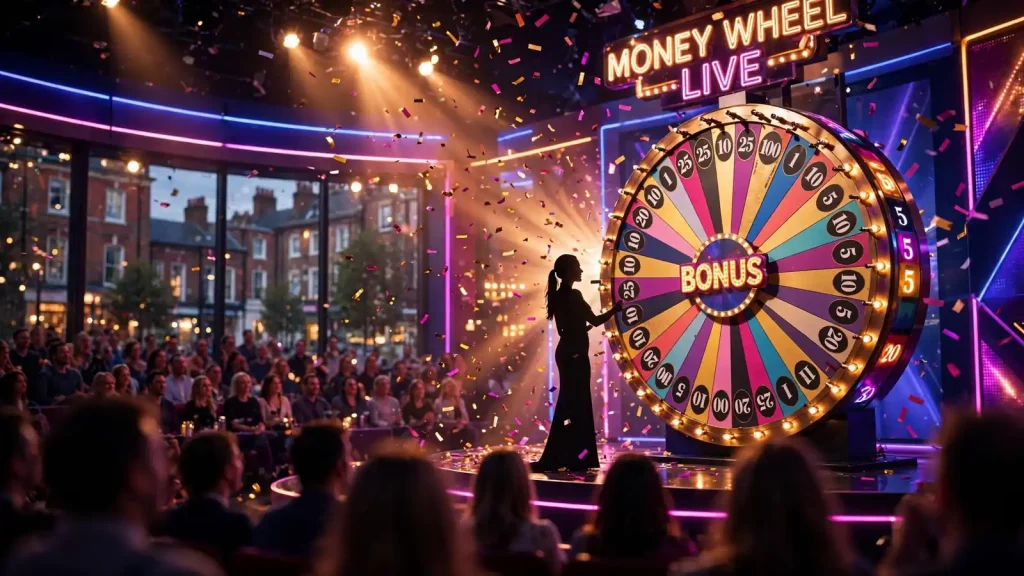
A guide to the studio-and-stream format, practice play, UK casino context and the limits of claims about games and offers.
Table of Contents
- Crazy Time Online: The Live-Casino Setting
- Crazy Time and the UK Casino Context
- What a Casino Site Can—and Cannot—Tell About the Game
- Where Live Casino Play Fits
- Choosing a Live-Casino Setting Without a Winners’ List
- A Review of Live Play, Limits and Betting Systems
- The Dealer, the Stream and the Table
- Free Play: A Practice Mode, Not a Payout
- GamStop, UK Licensing and the Limits of What Can Be Claimed
- Bonuses at Live Tables: Read the Small Print
Crazy Time Online: The Live-Casino Setting
The words “Crazy Time online” point towards a particular kind of screen-side entertainment: a casino game presented as a live show rather than as a sequence generated entirely by software. But the name alone does not explain how any particular version is produced or what appears in it. The useful starting point is the live-casino format itself, and the division of labour it creates between a studio and the person watching from elsewhere.
In a live dealer game, the central action is filmed in real time in a studio. A human dealer is present, while an online player sees the proceedings through a stream and uses an on-screen interface to place bets. The screen is therefore doing two jobs. It carries the view of the live event, and it provides the controls for participating in the game. The experience is not simply a video watched passively, nor is it only a digital game animated in response to a click. It joins a physical performance to a software interface.
When choosing a casino for Crazy Time, it helps to consider practical details alongside the game itself. This list offers a quick reference to the payout-speed information available for each operator.
1. Jetsetspins
Payout speed: 1-3 business days Jetsetspins lists a payout speed of 1–3 business days. This is the available practical detail to consider when exploring it for Crazy Time.
2. NightWin
Payout speed: 1-3 business days NightWin lists a payout speed of 1–3 business days. The provided information offers a concise point of reference for players considering it.
3. Amunbet
Payout speed: 1-3 business days Amunbet lists a payout speed of 1–3 business days. That payout timeframe is the only operator detail available here.
4. NightLuck
Payout speed: 1-3 business days NightLuck lists a payout speed of 1–3 business days. This gives readers a clear payout-related detail to keep in mind.
5. Chanze
Payout speed: 1-3 business days Chanze lists a payout speed of 1–3 business days. The listed timeframe is the available factual detail for this reference.
6. Zombillion
Payout speed: 1-3 business days Zombillion lists a payout speed of 1–3 business days. This provides one practical detail for readers assessing their options.
7. BeOnBet
Payout speed: 1-3 business days BeOnBet lists a payout speed of 1–3 business days. No other operator-specific details are provided here.
8. SpinFormula
Payout speed: 1-3 business days SpinFormula lists a payout speed of 1–3 business days. This is the available information relevant to its place in this quick reference.
9. Dieselwin
Payout speed: 1-3 business days Dieselwin lists a payout speed of 1–3 business days. Readers can use this as a payout-related consideration when exploring the operator.
10. x3bet
Payout speed: 1-3 business days x3bet lists a payout speed of 1–3 business days. The provided information does not establish any further operator-specific features.
That arrangement gives the format its particular tension. The action belongs to a room that exists somewhere beyond the player’s screen; the choice to bet belongs to the interface. The two meet through the stream, which makes an online casino table feel less like a solitary calculation and more like a small broadcast. Yet the sense of presence has limits. A camera can show a dealer and a studio, but the player still interacts through buttons and menus, not by speaking across a table or handling the equipment.
For someone looking at Crazy Time in an online casino, this distinction matters before any consideration of rules. A title can be associated with a live-show presentation without every detail being inferable from its name. The live-casino label describes a mode of delivery: real-time studio gameplay, a human dealer, and bets entered on screen. It does not, by itself, establish the exact sequence of play, the available betting choices, the visual design, or the rules of a specific game. Those belong to the particular game and its presentation, not to the general category.
NetEnt Casinos in the UK: Games, Offers and Checks
The interface is a quiet piece of theatre. It turns a physical event into a set of choices that can be made remotely, while keeping the machinery of participation visible enough to operate. A player might watch the studio feed in one part of the screen and use controls elsewhere; the precise layout depends on the game. What is constant in the general format is the separation between seeing the action and submitting a bet. The player’s action is digital. The dealer’s is performed in the studio.
That separation also explains why “online” does not mean that every element is virtual. The stream carries real-time gameplay from a studio with a human dealer, while the interface mediates the player’s decisions. A digital version, by contrast, may use computer-generated play rather than a filmed studio event. The distinction is not a question of which one is more authentic. It is a difference in how the game is made present: one through a live broadcast, the other through software rendering.
Deal or No Deal Casino UK: How the Game Works
The broadcast lends the experience a social surface, even when the player is physically alone. A dealer’s presence gives the screen a human point of focus; the camera frames the table or studio as an event unfolding now, rather than a result appearing after a command. That can change the texture of play without changing the basic fact that the player is using an interface. The format borrows some conventions of television—framing, performance, a visible presenter—while retaining the private, individual nature of online betting.
This is a curious modern compromise. Casino play has long depended on rules that turn uncertainty into an organised public ritual: a table, an attendant, a set of accepted actions. The online live format preserves the visible human figure and the sense of an event, then removes the shared room. The player is close enough to watch, but not present enough to occupy the same space. The dealer performs for a camera; the interface translates participation into taps or clicks.
Amatic Online Casinos in the UK: Games and Access
For a search for a Crazy Time casino online, the phrase “live” should therefore be read as a description of format, not as a complete account of the game. It signals a streamed studio setting when the specific offering is indeed presented as a live dealer game. It does not settle what the game contains or how its rules work. Those details need to be read from the game’s own display and instructions, rather than supplied by assumptions about what a show-like title must involve.
The essential arrangement remains simple: a studio sends live gameplay to a screen, a human dealer is part of that scene, and the player places bets through an interface. One room, two kinds of action.
Crazy Time and the UK Casino Context
A live casino game does not sit outside the law simply because its table is streamed rather than housed in a conventional casino. In the United Kingdom, live dealer casinos are legal when they hold a licence from the UK Gambling Commission. That distinction is the useful starting point for understanding Crazy Time in a UK casino context: the name of a game and the legal status of the service carrying it are separate matters.
Crash Casino Games in the UK: How the Market Works
This can sound like a narrow administrative point. It is not. Gambling regulation draws a boundary around who may offer real-money play to people in the country, not around how theatrical a game looks or whether it resembles a television show. A studio set, a presenter and a live feed may change the atmosphere of the experience; they do not, by themselves, establish that the operator is authorised to provide it.
The word “casino” can blur that boundary. It may refer to a physical place, an online service or, in everyday speech, a particular game. “Crazy Time casino” can therefore mean a casino game with that title, a site said to offer it, or a general search for live play. Those meanings should not be collapsed into one. A game’s name does not identify the legal entity offering it, and a site’s presentation of a game does not make the site licensed.
That separation matters because regulation attaches to the operator’s activity. A UK Gambling Commission licence is the relevant marker for a live dealer casino operating legally in the UK. The visual language of a game—its studio, host or branded interface—cannot substitute for that status. Nor does the presence of a familiar title prove that every service using it is operating under the same conditions. The licence belongs to the regulated business, not to a search phrase.
There is a social history in this distinction. Gambling has long borrowed the forms of entertainment: the table, the show, the performance of chance. Online, those forms travel easily across borders, while national rules do not. A stream can make a distant studio feel close at hand, but the screen does not erase the obligations that apply to a business serving customers in the UK. The law is less interested in the costume than in the arrangement behind it.
UK Licensing
A title alone is not a licence; only a UK Gambling Commission licence proves an operator is authorised to provide real-money gambling in the UK.
That is why claims about “Crazy Time live casino UK” need careful grammar. The phrase can describe a player’s interest in a live game, but it cannot prove which provider runs it, what version is available, or whether a particular site has permission to offer real-money gambling. Those are different claims, each requiring its own evidence. A title alone is not a licence, and a page mentioning the UK is not proof of authorisation.
The distinction also prevents a common category error: treating the legal status of live casino games as a specific endorsement of one game. The broad rule is that live dealer casinos are lawful in the UK when they hold the UK Gambling Commission licence. It does not follow that every game advertised as Crazy Time is necessarily available through a licensed operator, or that every site using the name has the same status. The rule concerns the regulated setting; it does not certify every individual listing.
In practice, the UK context is therefore not a verdict on the game’s entertainment value. It is a framework for the business that offers it. This may seem less vivid than the set and its bright machinery, but it is the more consequential part of the arrangement. A live show can borrow the language of television. Real-money gambling still answers to regulation.
The name attracts attention; the licence carries responsibility.
What a Casino Site Can—and Cannot—Tell About the Game
A page offering Crazy Time in a casino lobby can describe the setting in which the game is accessed. It can show how the live table is presented, where the betting controls appear and what information is displayed before play begins. Those details matter. They describe the service around the game, not a promise about what the game will do.
Casino Dice Games in the UK: Odds and Online Play
The distinction is easy to blur. A polished page may place a title beside energetic language about action or winning, while a compact panel contains the useful particulars: whether play is live, what controls are available and how the table communicates its state. The first is atmosphere. The second is information.
A casino site can also explain the practical demands of live play. Live games move more slowly than digital versions, carry higher minimum bets and depend on a stable internet connection. These are not decorative details. A streamed table has a pace set by events unfolding in real time, rather than by a screen that can complete each step immediately. The difference affects how a session feels, even before any question of outcome arises.
Reading the page, not the promise
Descriptions of a game should be separated from descriptions of the site’s own interface. A page may explain where a bet is placed or how the display changes during a round; that is a claim about the presentation. It cannot turn a lively visual treatment into evidence that a particular outcome is more likely. Nor does a prominent “scores” panel, if one is shown, establish a reliable way to anticipate what follows.
The word “score” can suggest a settled record, as if the display were a table of form. In a casino interface, it may simply be information presented alongside the game. A record of previous events does not change future spins or make a sequence easier to forecast. The distinction is plain, though promotional design often prefers a more suggestive mood. Numbers look authoritative. They are not automatically instructive.
In a casino interface, a record of previous events is information presented alongside the game, not a dependable guide to future results.
This matters when a site describes Crazy Time scores or offers a history-like display. Such material can help explain what the interface is showing at that moment, but it should not be mistaken for a strategy or a map of future results. A site can tell what its screen labels mean. It cannot make past results a dependable guide to what comes next.
Claims need a proper scale
The same restraint applies to claims about a live experience. A site may explain the pace, describe the controls and present the game’s rules. It may also use language designed to make the session feel unusually immediate. The streamed format does have a distinctive quality: events arrive as they happen, rather than being simulated on demand. But vivid presentation is not evidence of better prospects.
A useful description stays close to what can be observed. It explains how the table is accessed and what the player sees, without implying that an interface feature changes the underlying chance of an outcome. A less useful description dresses routine information in the language of certainty. Casinos have long traded in spectacle; the screen has not abolished the old distinction between theatre and fact.
This is why a search for the best Crazy Time casino sites cannot be settled by slogans alone. The relevant question is not which page sounds most confident, but whether its description lets the live setting be understood without confusing presentation with prediction. That is a modest standard. It is also the honest one.
UK Casinos with Push Gaming Slots: How to Check
For a UK player, Crazy Time casino sites are gateways to a particular kind of online table, not interpreters of its future. The site can set out the environment and explain the information it displays. It cannot make a sequence of results legible in advance. A score is a record, not a forecast. A good interface clarifies the distinction; a sales pitch may prefer not to.
Where Live Casino Play Fits
A live casino game occupies a different kind of time from a digital one. The screen is not simply producing an outcome at the pace of a software interface: the action unfolds in a streamed setting, and the player’s decisions have to fit around that rhythm. For someone looking to play Crazy Time live, the practical distinction is less about the shape of a game than the conditions its format imposes.
The pace is slower than in digital versions. There is a pause between opportunities to act, and the sequence cannot be hurried along to suit a player’s preferred tempo. That can make a live session feel more like waiting for a shared event than moving through a succession of instant results. The interval is part of the format, not a technical fault. It also means that a live game may be a poor fit for a brief moment when attention is divided or time is tight.
Pacing
Live sessions move slower than digital versions, with pauses between opportunities to act.
Connectivity
Stable internet links are required to avoid interruptions in the real-time stream.
Entry Costs
Minimum bets are typically higher in live games than in their digital counterparts.
The connection matters for the same reason. A live game depends on a stable internet link; an interrupted or inconsistent stream can make the experience difficult to follow. This is not merely a question of picture quality. When the action is happening in real time, a delay or break can unsettle the player’s sense of what is taking place and when a decision belongs. A reliable connection is a practical requirement, not an embellishment.
The other adjustment is the minimum bet. Live games have higher minimum bets than digital versions, so the threshold for joining in may be less accommodating. That changes the texture of play before any result appears: a player has fewer ways to treat a live table as a low-cost test of the format. The difference is easy to overlook when the same game category appears in both live and digital forms, but the two settings do not necessarily ask for the same commitment.
This helps explain why “play live” is not simply a matter of opening a game and expecting the digital experience with a human presentation added. The live format brings its own pace, connection demands and entry conditions. Each is modest in isolation; together, they determine whether a session feels manageable or awkward.
A wheel-style game may look especially suited to a live presentation, because a visible sequence gives the waiting a focal point. Still, the appeal of seeing an event unfold does not remove the slower rhythm or the need for a stable stream. The screen can make waiting feel social and immediate, while the underlying constraints remain distinctly practical.
Live Dream Catcher Casino UK: How It Works
For many people, the relevant question is therefore not where a live game can be found, but whether the setting fits the available time, connection and intended stake. A live session asks for patience as well as attention. Digital play is often quicker; live play makes that difference plain.
Choosing a Live-Casino Setting Without a Winners’ List
A ranking of the best Crazy Time casinos would look decisive, but a name on a list is not evidence that a particular live game is available there, or that its presentation will suit every player. The more useful distinction is between a casino’s general claims and the conditions visible when a live table is opened. No badge can make a stream run smoothly or change the pace of a dealer-led game.
Live casino play joins two kinds of machinery: a studio stream and an on-screen betting interface. The dealer acts in real time; the player’s choices are entered through the screen. That arrangement is unlike a conventional digital game, where the action is generated by software and can move more quickly. It also means that the experience depends partly on the connection between the studio and the device. A weak or unstable connection can interrupt the thread of play.
This is a more useful test than searching for a “best” label. A casino setting should make the live nature of the game clear before play begins, and its interface should allow the betting options and timing to be understood without guesswork. The stream and the controls need to work together: a picture that arrives late, or a betting panel that is difficult to follow, makes a simple act of participation needlessly uncertain. Smooth presentation is not a promise of a better result. It is a condition of being able to follow what is happening.
Mines Casino Game in the UK: Rules and Risks
The slower rhythm matters, too. Live tables move at the pace of a studio dealing with real participants, rather than at the speed of a digital version. Minimum bets are also higher in live games than in their digital counterparts. Those differences can narrow the choice of setting for someone who wants quick rounds or very small stakes. They are characteristics of the format, not shortcomings that a promotional label can correct.
Terms such as “Crazy Time slot” can blur the distinction between a slot and a live casino game. A search phrase may use the familiar slot vocabulary, but the relevant question is whether the game is presented as live play, with a human dealer and a betting interface, rather than as a purely computerized experience. The name alone does not settle that point.
Nor can a results page turn past outcomes into a guide to future play. A result records what has happened; it does not make the next event more predictable. Strategies built around supposed patterns cannot alter the mechanics of a live game. The sensible standard for selecting a setting is less dramatic: clear presentation, understandable controls and conditions that fit the pace and connection available.
Before any session, a budget should be set and kept. Gambling is entertainment, not a source of income, and this discussion is not gambling advice. No ranking can remove that boundary.
Big Time Gaming slots in UK casinos: what’s verified
A Review of Live Play, Limits and Betting Systems
The phrase “strategy” can suggest that a game will yield to a pattern if only the pattern is found. In casino play, that promise often belongs to the betting system rather than to the game. A staking plan can change the size and sequence of bets; it cannot remove the house edge or make an uncertain result predictable. That distinction matters when considering claims about a Crazy Time live casino strategy: a general system is not evidence of a reliable advantage in a particular game.
Roulette offers a clear illustration of how the underlying terms matter. A straight-up bet, placed on one number, carries a house edge of 2.9%; other roulette bets carry an edge of 2.7%. The difference is modest, but it is part of the game’s mathematics, not a judgement on a player’s timing or nerve. A bet that covers more outcomes may feel safer because it wins more often, yet frequency alone does not tell the whole story. The payout and the house edge belong in the same calculation.
Betting systems tend to put more emphasis on the sequence. Martingale, for instance, involves increasing a stake after a loss in an attempt to recover earlier losses when a win arrives. The arithmetic looks tidy on paper and is less obliging in practice: a run of losses can make the required stakes grow, while available funds and table limits constrain how far the progression can continue. Blackjack, like other casino games, retains a house edge; using Martingale does not erase it. A system can redistribute risk across rounds, not abolish it.
Do
- Set a budget before play
- Keep to your established limit
- Treat the session as entertainment
Don’t
- Use betting systems to erase house edges
- Chase losses or winnings
- Rely on patterns in historical trackers
The same caution applies to casino trackers. A record of previous outcomes may describe what happened, but it does not alter what happens next. Statistics trackers cannot make a future spin or Lightning Number more likely to land in a particular way. Patterns observed after the event can be compelling, especially when a display turns a run of results into a neat sequence. Neatness is not predictive power.
This also sets a boundary around talk of Crazy Time casino history. Historical information may explain where a game or convention came from, but it does not supply a betting method. Nor does a tracker become a strategy merely because it presents past results in orderly columns. Past records are records. They are not instructions from the future.
The practical discipline is less dramatic: set a budget before play, keep to it, and do not chase losses or winnings beyond that limit. Betting systems can make escalation feel methodical, which is not the same as making it safe. The numbers remain indifferent.
This is entertainment, not gambling advice.
The Dealer, the Stream and the Table
A live table has a human presence at its centre. The game is filmed in a studio, where a dealer conducts play as it happens; the stream carries that scene to an online screen, while bets are entered through the site’s interface. The table and the betting panel share the same moment, but they are not the same thing: one shows the physical action, the other records a player’s choices.
That distinction matters when a name such as Crazy Time appears beside a live-casino label. The label describes a mode of presentation, not a guarantee that every feature associated with a game can be inferred from the words alone. A live dealer format means streamed play with a person at the table. It does not, by itself, establish the rules, set pieces or pace of any particular title.
Chicken Road Game in UK Casinos: What to Know
The dealer’s role is both practical and theatrical. A physical action is visible, and its result arrives through the stream rather than being represented solely by a computer-generated animation. The dealer gives the table a human rhythm: gestures, pauses and the ordinary business of conducting a game. This can make online play feel closer to watching a table than operating a piece of software. The screen remains a screen, of course.
The contrast is especially clear in roulette. In live dealer roulette, a dealer spins a physical wheel. Computerised roulette instead relies on a Random Number Generator, which produces the result digitally. The difference is not a promise that one format is more favourable; it is a difference in how the outcome is produced and presented. A camera can show a wheel turning, while software can display a result without one.
That distinction also changes what “watching” means. In a streamed game, the visible scene is part of the play: the dealer and table are not decorative images added after a result has been generated. In a computerised game, animation may portray the action, but the underlying mechanism is the random-number system. Neither presentation turns chance into something readable. A moving wheel is still not a forecast.
Progressive Jackpot Slots: How They Work
Online tables combine the studio view with controls for placing bets. The interface gives the remote player a place in the proceedings, but not a seat in the room. In live blackjack, for instance, players can see and interact with the dealer, and some games may provide chat with the dealer and other players. That social layer is modest and mediated by the screen; it does not make the setting private or in-person.
The attraction of live play lies partly in this visible human process: a game unfolding rather than a result appearing from nowhere. Its limits are just as visible. A stream can show what is happening, not what will happen next.
Free Play: A Practice Mode, Not a Payout
The phrase “play for free” can describe quite different things: a game opened without a cash stake, a promotional offer, or simply a page describing how play works. Those are not interchangeable. A free-play game is a simulation, not a quieter route to a real-money return. It does not pay out winnings.
Big Jackpot Slots in UK Online Casinos: The Rules
That distinction matters when looking for a free version of a live casino game such as Crazy Time. A page may use familiar imagery or explain the format, but that alone does not establish that it is an official demo, that it uses the same conditions as real-money play, or that it includes free spins. Claims of a free mode are worth reading literally: what is being offered, and what, if anything, can be withdrawn? If the answer is unclear, the wording is doing more work than the product.
Practice can still have a modest purpose. It may help show how an interface is arranged or make the sequence of a game less unfamiliar. It cannot reproduce the financial consequence of staking real money, and a run of simulated outcomes says nothing dependable about what will happen in later play. A practice screen is not a forecast.
Reviews should be read with the same separation in mind. A favourable account of a game’s presentation is not proof that a particular free version exists, nor is it evidence that a site is safe. Safety depends on the setting in which real-money gambling takes place, not on the reassuring label attached to a demo. A free-play page should not be mistaken for a licence, an endorsement or a route to cash winnings.
There is also a social difference between watching and wagering. A streamed table may make a game feel immediate, but simulated play removes the financial risk rather than converting it into a harmless version of the same event. The distinction is plain; marketing language can make it less so.
For anyone comparing a free casino game with its real-money counterpart, the useful question is not whether the practice version feels convincing. It is whether its limits are stated clearly and whether it is being presented honestly as play without payouts. Free means no real-money winnings. That is the boundary.
This article is for entertainment purposes only and is not gambling advice.
Is “non-GamStop” the same as being legal in the UK?
No, “non-GamStop” refers to a site’s relationship with a self-exclusion system, while legality depends on holding a UK Gambling Commission licence.
Do casino bonuses always apply to live tables?
Not necessarily; many welcome offers are restricted to slots and may have low contribution weightings for live games.
Does a free-play mode pay out winnings?
No, a free-play game is a simulation for practice and does not provide real-money returns.
GamStop, UK Licensing and the Limits of What Can Be Claimed
The phrase “not on GamStop” often appears beside searches for a Crazy Time casino. It describes an apparent distinction between a gambling site and the UK’s self-exclusion scheme, but it does not establish that the site is lawful for people in Britain, or that it is suitable for them. A label is not a licence.
The relevant legal test is more specific. Live dealer casinos can operate legally in the UK when they hold a licence from the UK Gambling Commission. That applies to the operator offering the gambling, not merely to the game’s name, studio presentation or association with a familiar title. A site’s marketing cannot substitute for the licence that British regulation requires.
GamStop has a different role: it is a self-exclusion programme, not a regulator and not a mark of casino quality. Treating absence from the scheme as a selling point turns a protective boundary into a shopping feature. That is an uneasy inversion. For anyone who has chosen self-exclusion, a route advertised around avoiding it is not simply another version of the same entertainment; it may undermine the decision that the scheme was intended to support.
The words “Crazy Time” also do not settle the question. A search result may attach them to a site or claim a connection with a game, but the name alone says nothing about the operator’s UK status. Nor does a site’s location abroad remove the requirement to hold the appropriate UK licence when it offers remote gambling to British customers.
In practice, “non-GamStop” and “legal in the UK” are not interchangeable descriptions. The first concerns a site’s relationship to a self-exclusion system; the second concerns whether the operator is authorised to serve the market. For live dealer play, the clear dividing line is a UK Gambling Commission licence. Entertainment, not gambling advice.
Eyecon Slots at UK Casinos: Check the Provider
Bonuses at Live Tables: Read the Small Print
A Crazy Time casino bonus can sound more relevant than it is. The word “casino” on an offer does not mean every game qualifies, and a welcome promotion may be built for slots rather than live tables. A specialist review describes most UK welcome offers as free spins on slots that cannot be used at live tables. That distinction matters before any bonus is treated as part of a live-game balance.
Where live games are eligible, their contribution to wagering requirements may be low. A stated weighting of 10%, for instance, means that only a small portion of qualifying live-game stakes counts towards the requirement. The headline offer can therefore appear generous while progress through its conditions remains slow. The arithmetic is quieter than the banner.
A Crazy Time casino bonus in the UK should be read through its terms, not its label. The terms need to say whether the game is eligible, what contribution applies and whether any limits affect the offer. A deposit bonus may have different conditions from a no-deposit offer; neither wording establishes that it can be used on a particular live game. No-deposit promotions are not a promise of accessible funds or winnings.
Classic Slots Online in the UK: How They Work
The same caution applies to claims about Crazy Time casino payouts. A bonus is not a payout, and promotional funds do not establish what a game will return. Any applicable wagering conditions remain separate from the game’s outcome. A casino bonus UK offer dated for 2026 should be judged by the terms displayed when it is offered, rather than by an old description or a broad welcome headline.
The practical test is simple: identify eligible games, weighting and any maximum-bet conditions before opting in. If the offer is restricted to slots, it has no use at a live table. If live games count only lightly, the bonus may be less useful there than its headline suggests. Entertainment, not gambling advice.
How do you choose a live dealer casino?
Choose a live dealer casino that holds a UK Gambling Commission licence.
What are the different types of roulette you can play with a live dealer?
Live roulette includes European, American and French versions. American Roulette has both 0 and 00, while European Roulette has a single 0.
How do you play live roulette?
Place your bet through the on-screen interface, then watch the dealer spin a physical wheel. You win if the ball lands on a number you selected.
How can you win at live dealer roulette?
You win when the ball lands on a number you selected. European Roulette gives you odds of 1 in 37, compared with 1 in 38 in American Roulette.
Games

Aviator Casino Game UK: Licensing, Bonuses and Play
A guide to UKGC authorisation, casino conditions and the limits of claims about Aviator’s format,...
3-Reel Slots in the UK: Classic Play, Modern Rules
A guide to the familiar reel layout, its online setting, free-play sessions and the regulatory...
5-Reel Slots in the UK: Rules, Free Play and Payouts
Five reels describe the screen, while regulation, demo play, bonus rounds and payout expectations answer...

Amatic Online Casinos in the UK: Games and Rules
A practical guide to Amatic slot features, UK rules, casino availability, deposits and the limits...

Android Casinos UK: Games, Apps and Licensing
Android access depends on a UKGC-licensed operator; Amatic supplies games, while app availability and payment...

Barcrest online casinos in the UK: what can be verified
Supplier licensing, casino listings and game catalogues provide different kinds of evidence about whether Barcrest...

Betsoft Casinos in the UK: What Can Be Verified
The page distinguishes supplier and operator claims, explaining why a catalogue or broad brand list...

BGaming Slots in UK Online Casinos: Rules Explained
The UK slot framework applies to BGaming games offered by licensed operators, but the brand...

Bingo Casinos UK: How Online Slot Rules Differ
Slots follow cycle-based stake and pace rules, while bonuses, licensing and availability depend on the...

Blueprint Gaming Casinos in the UK: Evidence
A supplier name does not establish which UK casinos offer Blueprint games, or confirm their...

Bonus Buy Slots in the UK: How the Feature Works
A bonus buy pays the displayed price to enter a feature directly, but the slot...
Online Craps Casinos in the UK: What to Check
Craps pages may describe a game, a digital table or a live experience, so casino...

Amatic Slots at UK Casinos: How They’re Distributed
Amatic supplies gambling software rather than operating a casino, and each operator decides which titles...

Elk Studios Online Casinos in the UK
The wording around slot games, online casinos and availability can signal interest, but a search...

Amatic Casino Games in the UK: How Access Works
Amatic supplies the games, while the casino operator manages the account, bets and player-facing services....

Evolution Gaming Casinos UK and Amatic Slots
A look at Amatic slot mechanics, casino availability and the difference between the supplier discussed...

Fast Payouts at UK Online Casinos: Keno Explained
Keno’s house edge describes the casino’s statistical advantage over repeated play, while payout timing concerns...

First-Deposit Casino Bonuses in the UK: Terms
First-deposit promotions can depend on eligibility, activation steps and rules for using or withdrawing funds....

Greentube and Amatic Casinos in the UK: What to Know
Explore Amatic’s slot format, provider distinctions and what the available information can—and cannot—confirm about UK...
Habanero Slots at UK Casinos: Games and Availability
The guide explains how catalogues, licensing, game access, slot characteristics and casino terms fit together...

High-Volatility Slots in the UK: How Payouts Work
High volatility means wins tend to be less frequent and larger, while low volatility spreads...

Amatic Slots at UK Online Casinos: What to Know
Amatic makes the games, while UK-licensed operators provide the accounts, deposits, bonuses and withdrawals. The...

Inspired Gaming Casinos in the UK: What to Verify
A provider name alone does not confirm that a UK-facing casino currently offers its games....

Amatic Online Casinos in the UK: Games and Terms
A practical overview of Amatic slot formats, casino availability, bonus conditions and the boundaries between...

Best Keno Online Casinos in the UK: What to Compare
Keno compares selected numbers with a random draw, so casino terms and the house edge...

Live Casino in the UK: Rules, Games and Offers
Live casino choices are shaped by UK licensing, streamed table formats, operator practices and the...
Low-Volatility Slots in the UK: How They Play
Volatility describes how returns are distributed, not when a win will arrive or what a...
Amatic Online Casinos in the UK: Games and Access
Amatic supplies games to casino operators, so its titles appear within operator platforms rather than...

UK online casino sites: understanding Amatic slots
A clear guide to reels, paylines and free spins, and to the difference between slot...

Amatic Online Casino Games in the UK: How They Work
This guide separates Amatic’s software role from casino operation and explains how its games reach...

UK Online Casino Game Shows: Formats and Limits
The term describes a hosted entertainment format, but listings alone may not reveal how a...

Online Casinos With No Betting Limits: What to Know
The phrase can describe an aspiration, but each game and account may have different rules,...

Big Jackpot Slots in UK Online Casinos: The Rules
See how Great Britain’s gambling framework applies to online slots, and how real-money play, free...

Big Time Gaming slots in UK casinos: what’s verified
The available information separates provider identity, UK licensing and casino availability without treating Amatic facts...

Divine Fortune UK Casinos: Amatic Facts and Checks
A practical guide to identifying Divine Fortune, understanding Amatic’s role and checking access, bonus terms...

Eyecon Slots at UK Casinos: Check the Provider
The distinction between Eyecon and Amatic matters when checking game availability, casino operators, demo access...

Jackpot King Slots at UK Online Casinos
Jackpot King’s name does not identify its developer or confirm which licensed casino offers the...

Mega Moolah in UK Online Casinos: What to Know
A guide to finding the title in UK casino lobbies while separating game details, slot...

Megaways Slots at UK Online Casinos: What to Check
Megaways is a format label, while each game's rules and the casino's licensing and terms...
Amatic Slots at UK Casinos: Microgaming Mismatch
Amatic is an Austrian business-to-business supplier founded in 1993; Microgaming is a separate name in...

NetEnt Casinos in the UK: Games, Offers and Checks
A provider name does not prove which UK casinos offer its games or whether a...

NoLimit City Slots at UK Casinos: What to Check
A practical distinction between provider listings, individual slot features and casino claims that the available...

Play'n GO Slots at UK Casinos: What to Check
A look at game rules, RTP, bonuses and mobile play, distinguishing catalogue labels from each...

UK Casinos with Push Gaming Slots: How to Check
Casino catalogues can vary by brand and jurisdiction, so availability is best checked on the...

Red Tiger Slots at UK Casinos: What to Check
A provider name identifies an association, but the individual game rules, features and casino listing...

Thunderkick Slots at UK Casinos: What the Search Means
A guide to interpreting searches for Thunderkick titles and casinos without assuming a catalogue or...

Yggdrasil Slots at UK Online Casinos: What to Know
Yggdrasil is a game provider, while casino availability and UK licensing depend on the operator....
Online Slots Payout Percentage: What RTP Means
A slot’s stated return is a long-run relationship between stakes and returns, not a prediction...

Pariplay Online Casinos in the UK: What to Check
An evidence-led look at Pariplay slots, UK play conditions and what a casino listing can—and...

Playtech Online Casinos in the UK: What’s Verified
A careful look at game attribution, casino availability and the evidence needed to support Playtech...

Pragmatic Play Casinos in the UK: Games and Terms
The provider label identifies who supplied a game, but its mechanics, features and bonus conditions...

Progressive Jackpot Slots: How They Work
Progressive slots are catalogue games whose availability and placement can vary by operator; the category...

Quickspin Online Casinos UK: Games and Checks
Provider labels, game availability, offers and regulatory oversight do not all prove the same thing....

Real Money Online Casinos in the UK: Amatic Games
Amatic supplies games to gambling businesses, while the casino operator runs the customer account and...

Relax Gaming Casinos UK: What Can Be Verified
A provider label alone does not establish which slots UK players can access or verify...

Amatic Casinos UK: Games, Operators and Payouts
Amatic supplies software to casino operators, while the operator hosts the games, sets the offer...
RTP Casino Slots in the UK: How Returns Work
RTP describes a theoretical return across extensive play, while short sessions can produce very different...

Amatic Slots in UK Casinos: Games and Rules
Amatic games use familiar reel layouts, but their payline, feature and casino terms still need...

High-RTP Slots in the UK: What RTP Can Tell You
RTP is a long-run mathematical measure, not a forecast of an individual session; volatility and...

Stakelogic Casinos in the UK: Games and Availability
A guide to checking game availability, casino access and offer terms without treating unverified listings...

Video Slots in the UK: Reels, Risk and Free Play
A guide to how slot layouts, free-play modes and account features shape the experience. How...

Wazdan Online Casinos in the UK: What Can Be Verified
Game catalogues, supplier identity, availability and bonus claims are considered alongside the limits of the...

Casino Dice Games in the UK: Odds and Online Play
Online dice games can imitate a physical table, while computer-generated numbers—not the animation—determine random-number outcomes....
Chicken Road Game in UK Casinos: What to Know
A look at Chicken Road’s casino classification, demo play, bonus rules and the limits of...

Classic Slots Online in the UK: How They Work
A look at how classic slots present their controls and features, and how free play...

Crash Casino Games in the UK: How the Market Works
Explore how crash games compare with other casino categories and how licensing, fairness claims and...

Deal or No Deal Casino UK: How the Game Works
The television contest’s briefcase tension carries into an online game of qualification, Banker’s offers and...

Fastest Payout Online Casino UK: What It Means
A casino may record winnings before a withdrawal is requested, while arrival at the chosen...
French Roulette Online in UK Casinos: Zero Explained
The zero shapes roulette’s house edge, while La Partage can return half of an eligible...

Fruit machine slots UK: how online reels work
A practical overview of fruit-slot formats, features, demos and the differences between online play and...

Hi-Lo Casino UK: Rules, Rounds and Online Play
A clear guide to comparing each card with its successor, the choices available, and how...

JetX Casino Game in the UK: Slots, Demo and Offers
JetX is discussed alongside slots, demos and casino offers, but those labels alone do not...

Live Baccarat in UK Online Casinos: Tables and Play
The guide explains how live tables work, what bets mean, and how UK availability and...

Live Blackjack Online Casinos in the UK: How Tables Work
Live blackjack puts a human dealer on screen, bringing real-time play and possible interaction to...

Live Casino Lightning Roulette UK: How It Works
A clear look at the studio, betting interface, roulette rules and practical differences between online...
Live Dream Catcher Casino UK: How It Works
A practical look at how Dream Catcher is played live, what the word “wheel” tells...
Live Roulette UK with English-Speaking Dealers
A physical wheel is streamed from a studio while players place bets remotely through an...

Mines Casino Game in the UK: Rules and Risks
The UK market includes UKGC-licensed and offshore casinos, while demos, patterns and strategy each have...

Monopoly Live Casino in the UK: How Live Play Works
Monopoly Live combines a studio-hosted game with online betting, creating an experience distinct from playing...

Online Bingo UK: How It Works Alongside Slots
Bingo centres on shared number draws and ticket patterns, while slots offer a different pace...

Online Casino Games for Real Cash in the UK
Understand how stakes, bonus conditions and withdrawal processing shape the difference between a slot win...

Online Casino Tournaments UK: Rules and Formats
Tournament rules determine which games count, how attempts are bounded, and whether free entry still...
Online Casino American Roulette UK: Rules and Odds
The double-zero changes the number of possible outcomes, affecting single-number chances on every spin. American...
European Roulette at UK Online Casinos: Rules and Odds
A practical guide to single-zero arithmetic, wager payouts and the differences between digital, live and...

Online casino without ID in the UK: verification rules
A sign-up without document requests does not remove a UK operator’s duty to verify players...
Penny Slot Machines in the UK: Costs and Rules
The lowest stake is only a starting point: paylines and total-stake settings determine what each...

Plinko Casinos in the UK: Rules, Play and Payments
A guide to Plinko play, licensing, offers and payments, with a focus on what the...

Progressive Slots Online in the UK: How Jackpots Work
Progressive slots link wagers to an accumulating jackpot; a game's theme or bonus round alone...

Top Rated Online Casinos in the UK: Ratings Explained
A practical look at UK licensing, Amatic slots, differing RTPs, bonus limits and the operator...
UK Gambling Casino Sites and Slots: What to Check
A practical guide to assessing slot choice, licensing, returns, bonus conditions and payments across the...






























































































































































































































































