Savaspin licence, operator and trust signals for UK readers
 Available in GB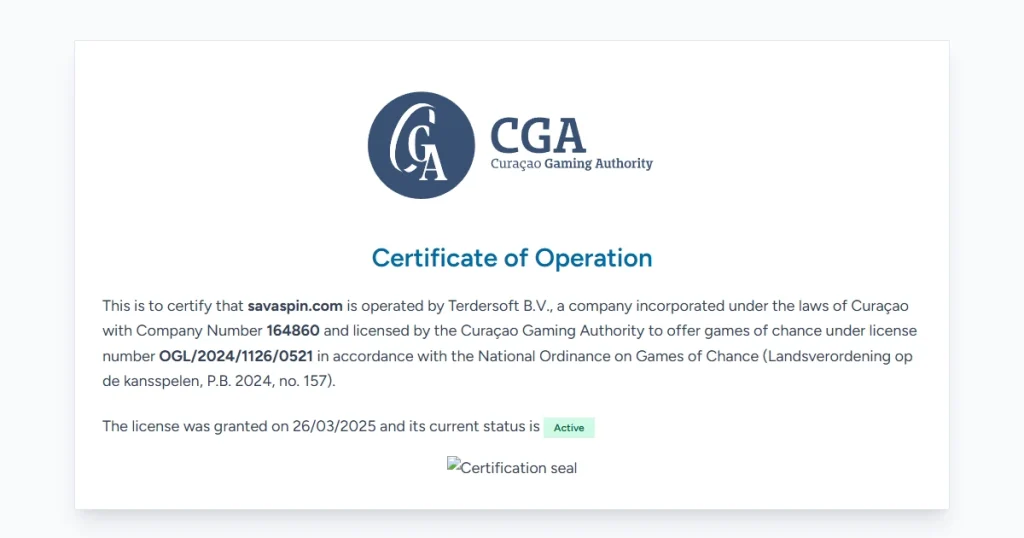
Primary-source licence audit
Savaspin.com is operated by Terdersoft B.V. The Curaçao Gaming Authority currently certifies the domain under licence OGL/2024/1126/0521, granted on 26 March 2025 and shown as Active. A same-session check of the UK Gambling Commission public register did not verify a UKGC licence for Savaspin or Terdersoft. That distinction matters because operators providing remote casino gambling to consumers in Great Britain need a Gambling Commission operating licence, regardless of where the operator is based.
Table of Contents
- What the Curaçao Gaming Authority certificate proves
- A Curaçao licence is not a substitute for a UKGC operating licence in Great Britain
- How to repeat the regulator check yourself
- Savaspin publishes account-level safer gambling controls
- GAMSTOP belongs to the UKGC framework, not to a generic offshore licence checklist
- Payments and identity checks are useful operational signals, but not licence substitutes
- Operator identity is also useful when checking account-facing information
- Certificate status should be checked again whenever the licence claim matters
- The official Terms create a separate UK access question
- Reputation evidence should be kept separate from regulator evidence
- What Savaspin’s Curaçao licence does – and does not – cover in Britain
- Savaspin licence, operator and trust signals for UK readers
What the Curaçao Gaming Authority certificate proves
The strongest licence evidence for Savaspin is the current Curaçao Gaming Authority Certificate of Operation. It names savaspin.com, identifies Terdersoft B.V. as the operator, gives company number 164860, and records licence OGL/2024/1126/0521. The certificate says the licence was granted on 26 March 2025 and currently has Active status.
Those details are useful because they tie three things together on a regulator-hosted page: the domain, the legal operator and the licence number. That is materially stronger than relying on a review site’s generic statement that a casino is “licensed”. It also gives readers a repeatable way to check whether the domain shown on a casino site is the same domain covered by the certificate.
| Certificate field | Current value | Why it matters |
|---|---|---|
| Domain | savaspin.com | Connects the certificate to the site being reviewed. |
| Operator | Terdersoft B.V. | Identifies the legal company named by the regulator certificate. |
| Company number | 164860 | Provides an additional operator identifier. |
| Licence | OGL/2024/1126/0521 | Gives the exact licence reference for future rechecks. |
| Status | Active | Shows the certificate is not merely historical in the current check. |
Local regulation
A Curaçao licence is not a substitute for a UKGC operating licence in Great Britain
The UK Gambling Commission’s remote casino guidance states that businesses providing gambling facilities to consumers in Great Britain need a Commission licence even when the business is based elsewhere. Great Britain means England, Scotland and Wales for this regulatory point.
Our current UKGC register check did not verify Savaspin or Terdersoft as a licensed UKGC business. That should be read as a separate local-regulation finding, not as evidence that the Curaçao certificate is invalid. The two questions are different: one asks whether an offshore licence exists, while the other asks whether the operator is licensed for the British regulated market.
How to repeat the regulator check yourself
A useful trust check should be reproducible. Start with the regulator certificate rather than a badge or footer claim, then search the local regulator separately. For Savaspin, the first step is to confirm that the CGA page names the same domain and operator. The second step is to use the UKGC business register, which can be searched by business name, trading name, domain name or account number.
- Match the exact website domain against the regulator certificate.
- Record the legal operator name and exact licence number.
- Check the status and the date the licence was granted.
- Search the UKGC register for the brand name, operator name and domain separately.
- Keep “no match verified” distinct from stronger claims that require additional legal evidence.
This method is more reliable than treating a logo in a casino footer as self-proving. It also makes later rechecks easier because the reader has the operator name and licence number rather than only the marketing brand.
Trust signals beyond licensing
Savaspin publishes account-level safer gambling controls
The current Savaspin Responsible Gaming Policy describes deposit limits that can be set on daily, weekly or monthly timeframes. It also refers to wagering limits, activity tracking and self-exclusion. A request to increase or remove a deposit limit is described as taking effect after a 24-hour delay, while a request to lower a limit can take effect immediately.
These are relevant product-level trust signals because they show the operator publishes concrete control mechanisms rather than only general safer-gambling language. They do not establish UKGC supervision. When comparing operators, it is useful to ask both whether tools exist and which regulator or licensing framework stands behind the operator.
GAMSTOP belongs to the UKGC framework, not to a generic offshore licence checklist
The UKGC’s current social responsibility code says applicable remote licensees must participate in the national multi-operator self-exclusion scheme. That is a requirement attached to the relevant UKGC remote licences. Because no UKGC licence was verified for Savaspin, this guide does not present Savaspin as covered by that UKGC scheme or by other UKGC consumer-protection arrangements.
This distinction prevents a common category error. A casino can publish its own deposit limits and self-exclusion tools while still sitting outside the licensing framework that makes GAMSTOP participation mandatory for applicable UKGC licensees. Product tools and market-level regulatory protections answer different questions.
Practical reading rule
If a trust feature depends on being a UKGC licensee, first verify the UKGC licence. Do not infer UK scheme participation from a foreign licence, an 18+ notice, safer-gambling links or the existence of an account self-exclusion function.
Payments and identity checks are useful operational signals, but not licence substitutes
Savaspin’s Terms contain named rules for deposits, withdrawals and identity checks, including same-owner payment requirements and verification before cashouts can be processed. Those controls matter when assessing how the account operates. The dedicated Savaspin payment methods guide explains the payment side, while the Savaspin verification guide focuses on KYC evidence and withdrawal interaction.
Neither operational detail should be used as a shortcut for licensing. A site can have structured KYC and payment rules and still require a separate local-regulator check. The strongest trust assessment therefore combines operator identity, regulator evidence, local-market status and practical account controls rather than relying on any single badge or feature.
Operator identity is also useful when checking account-facing information
The operator name on the regulator certificate gives readers a stable identifier that is more useful than the marketing brand alone. Brand names can be stylised, shortened or reused across different pages, but the CGA certificate ties savaspin.com to Terdersoft B.V. and company number 164860. If a future terms page, payment policy or support page names a different company, that would be a reason to pause and reconcile the mismatch before treating the information as current.
This matters at account level too. The Savaspin account and login guide focuses on the official domain and account access, while the licence page supplies the operator identity behind that domain. Used together, those checks reduce the chance of mistaking a lookalike site or an unrelated company reference for the operator actually covered by the certificate.
The same principle applies to payments and verification. A payment processor name is not automatically the casino operator, and a support address is not a regulator identity. When checking trust, keep the legal operator, payment service, software provider and marketing brand in separate categories unless a primary source explicitly connects them.
Certificate status should be checked again whenever the licence claim matters
The CGA page is useful partly because it shows a current status rather than only a licence number. Today’s certificate says Active, but licence status can change over time. A saved copy or an old review should therefore be treated as dated evidence. Readers checking Savaspin later should reopen the regulator page and confirm that the domain, operator, licence reference and status still match.
The UKGC side deserves the same freshness discipline. Its business register is a live regulatory dataset, and the current register page shows that records can be searched by business name, trading name, domain name or account number. A future UKGC match would materially change the local-licence conclusion, so the absence finding on this page is time-specific and should be rechecked rather than copied indefinitely.
This is one reason the page states “no UKGC licence was verified” instead of making a broader claim about every possible corporate relationship. The wording records what the current regulator check supports while leaving room for a later register update to be assessed on primary evidence.
The official Terms create a separate UK access question
Licensing and availability overlap, but they are not identical. Savaspin’s current Terms explicitly list the United Kingdom among restricted countries whose players are not allowed to deposit and play real-money games. That direct restriction is material enough to have its own UK availability evidence page rather than being buried inside the licence discussion.
For this page, the trust conclusion is narrower: an active Curaçao certificate is verified, a UKGC licence was not verified, and Savaspin publishes several account-level responsible-gambling controls. Whether a UK resident can actually use the product under the current Terms is a separate decision question.
Reputation evidence should be kept separate from regulator evidence
Complaints, review-site ratings and user reports can help identify service patterns, but they cannot prove a licence. They should therefore sit beside, not replace, regulator checks. The upcoming Savaspin complaints page is the right place to evaluate player-reported issues and how much weight to give them.
This separation improves information quality. A regulator certificate answers who is licensed and under which reference. A public register check answers local licensing status. Product policies show published controls. Complaint material shows reported user experience. Combining all four is useful, but none should be mislabeled as another category of evidence.
What Savaspin’s Curaçao licence does – and does not – cover in Britain
The current CGA certificate provides strong primary evidence that savaspin.com is operated by Terdersoft B.V. under active licence OGL/2024/1126/0521. It does not establish a UKGC licence or UKGC consumer-protection coverage. For readers in England, Scotland and Wales, the local regulator question remains decisive because remote operators serving Great Britain need a UKGC operating licence. Savaspin’s own safer-gambling controls are still useful product signals, but they should be assessed separately from UK market authorisation and from the site’s current UK access restriction.